sniffer_probes
Sniffer probes
Maximum occurrences (MDS+ backend only): 2
New in version 4.2.0: lifecycle status alpha
Changed in version 4.2.0.
ids_propertiesstructure
See common IDS structure reference: ids_properties.
probe(i1)AoS¶Set of probes
Set of probes
Maximum occurrences (MDS+ backend only): 10
1 |
|
probe(i1)/nameSTR_0D¶Short string identifier (unique for a given device)
Short string identifier (unique for a given device)
probe(i1)/antennastructure¶Antenna geometry
Antenna geometry
probe(i1)/antenna/geometry_typeINT_0D¶Type of geometry used to describe the surface of the detector […]
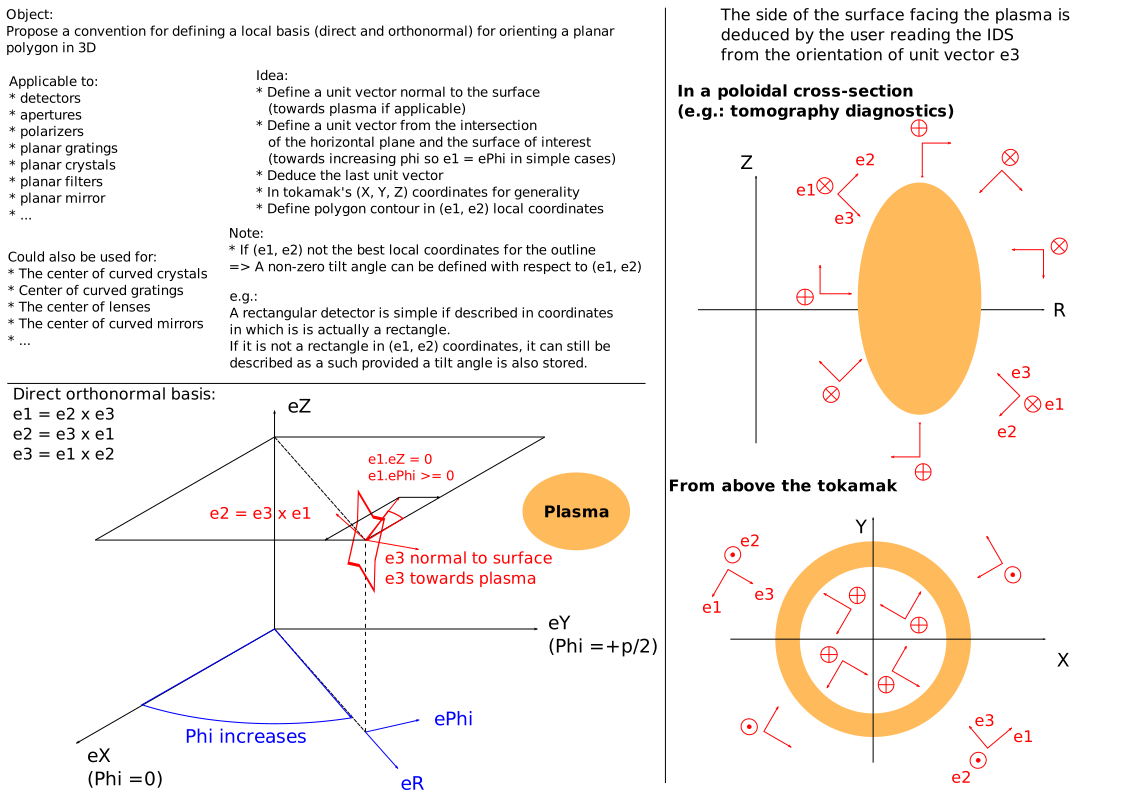
Type of geometry used to describe the surface of the detector or aperture (1:’outline’, 2:’circular’, 3:’rectangle’). In case of ‘outline’, the surface is described by an outline of point in a local coordinate system defined by a centre and three unit vectors X1, X2, X3. Note that there is some flexibility here and the data provider should choose the most convenient coordinate system for the object, respecting the definitions of (X1,X2,X3) indicated below. In case of ‘circular’, the surface is a circle defined by its centre, radius, and normal vector oriented towards the plasma X3. In case of ‘rectangle’, the surface is a rectangle defined by its centre, widths in the X1 and X2 directions, and normal vector oriented towards the plasma X3.
probe(i1)/antenna/centrestructure¶If geometry_type=2, coordinates of the centre of the circle. […]
If geometry_type=2, coordinates of the centre of the circle. If geometry_type=1 or 3, coordinates of the origin of the local coordinate system (X1,X2,X3) describing the plane detector/aperture. This origin is located within the detector/aperture area.
probe(i1)/antenna/radius ⇹mFLT_0D¶Radius of the circle, used only if geometry_type = 2
Radius of the circle, used only if geometry_type = 2
probe(i1)/antenna/x1_unit_vectorstructure¶Components of the X1 direction unit vector in the (X,Y,Z) coordinate […]
Components of the X1 direction unit vector in the (X,Y,Z) coordinate system, where X is the major radius axis for phi = 0, Y is the major radius axis for phi = pi/2, and Z is the height axis. The X1 vector is more horizontal than X2 (has a smaller abs(Z) component) and oriented in the positive phi direction (counter-clockwise when viewed from above).
probe(i1)/antenna/x2_unit_vectorstructure¶Components of the X2 direction unit vector in the (X,Y,Z) coordinate […]
Components of the X2 direction unit vector in the (X,Y,Z) coordinate system, where X is the major radius axis for phi = 0, Y is the major radius axis for phi = pi/2, and Z is the height axis. The X2 axis is orthonormal so that uX2 = uX3 x uX1.
probe(i1)/antenna/x3_unit_vectorstructure¶Components of the X3 direction unit vector in the (X,Y,Z) coordinate […]
Components of the X3 direction unit vector in the (X,Y,Z) coordinate system, where X is the major radius axis for phi = 0, Y is the major radius axis for phi = pi/2, and Z is the height axis. The X3 axis is normal to the detector/aperture plane and oriented towards the plasma.
probe(i1)/antenna/x1_width ⇹mFLT_0D¶Full width of the aperture in the X1 direction, used only if […]
Full width of the aperture in the X1 direction, used only if geometry_type = 3
probe(i1)/antenna/x2_width ⇹mFLT_0D¶Full width of the aperture in the X2 direction, used only if […]
Full width of the aperture in the X2 direction, used only if geometry_type = 3
probe(i1)/antenna/outlinestructure¶Irregular outline of the detector/aperture in the (X1, X2) coordinate […]
Irregular outline of the detector/aperture in the (X1, X2) coordinate system. Repeat the first point since this is a closed contour
Changed in version 4: Since this describes a closed countour first point must now be repeated at the end of the coordinate arrays of the children